


Page 10 - reflections_dyslipidaemia_newsletter9_Final
P. 10
REFLECTIONS
                                                                                                                   Dyslipidaemia
     Dyslipidaemia Global Newsletter #9 2025


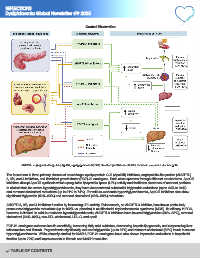
                                                     Central illustration                                          Dyslipidaemia


              ANGPTL, angiopoietin-like protein; ApoCIII, apolipoprotein C-III; FGF, fibroblast growth factor; MASH, metabolic-associated steatohepatitis.


     The focus here is three primary classes of novel drugs: apolipoprotein C-III (ApoCIII) inhibitors, angiopoietin-like protein (ANGPTL)
     3, 3/8, and 4 inhibitors, and fibroblast growth factor (FGF)-21 analogues. Each class operates through different mechanisms. ApoCIII
     inhibitors disrupt ApoCIII synthesis which upregulates lipoprotein lipase (LPL) activity and facilitates clearance of remnant particles.
     In clinical trials for severe hypertriglyceridaemia, they have demonstrated substantial triglyceride reductions (up to 44% to 94%)
     and remnant cholesterol reductions (up to 31% to 74%). For mild-to-moderate hypertriglyceridaemia, ApoCIII inhibitors also show
     significant triglyceride (59%–63%) and remnant cholesterol (48%–59%) reductions.

     ANGPTL3, 3/8, and 4 inhibitors function by increasing LPL activity. Evinacumab, an ANGPTL3 inhibitor, has shown particularly
     pronounced triglyceride reductions (up to 162% vs. placebo) in multifactorial chylomicronemia syndrome (MCS). Its efficacy in FCS,
     however, is limited. In mild-to-moderate hypertriglyceridaemia, ANGPTL3 inhibitors have lowered triglycerides (56%–63%), remnant
     cholesterol (64%–82%), non-HDL cholesterol, LDL-C, and apoB.


     FGF-21 analogues enhance insulin sensitivity, increasing fatty acid oxidation, decreasing hepatic lipogenesis, and suppressing liver
     inflammation and fibrosis. Pegozafermin significantly reduced triglyceride (up to 67%) and remnant cholesterol (52%) levels in severe
     hypertriglyceridaemia. While primarily studied for MASH, FGF-21 analogues have also shown impressive reductions in hepatic fat
     fraction (up to 72%) and improvements in fibrosis and MASH resolution.


          TABLE OF CONTENTS

