


Page 12 - reflections_dyslipidaemia_newsletter9_Final
P. 12
REFLECTIONS
                                                                                                                   Dyslipidaemia
     Dyslipidaemia Global Newsletter #9 2025


     analogues could potentially lower the risk for cardiovascular
     disease by 13%–22%, 16%–35%, and 6%–17%, respectively.             CLINICAL PEARLS FROM THE FACULTY           Dyslipidaemia

     Beyond their initial target indications, further research is needed
     to fully understand the metabolic fate of triglycerides after
     treatment with these novel drugs and to explore their potential
     for other indications within lipoprotein metabolism. The differing
     hepatic safety profiles observed also highlight the need for
     continued detailed study of their mechanisms and long-term
     effects. Overall, these novel drug classes offer a promising new
     direction in the management of dyslipidaemia and associated
     metabolic disorders, with the potential to significantly expand
     treatment choices for several challenging patient groups.
                                                                           WATCH
                                                                           PROF. SHAWKY DISCUSS THE
              CLICK HERE                                                   CLINICAL RELEVANCE OF THIS
              FOR THE LINK TO FULL ARTICLE                                 ARTICLE.


     SPECIAL POPULATIONS – HYPERCHOLESTEROLEMIA IN THE ELDERLY

     Managing hypercholesterolemia in adults older than 75 years without a history of

     atherosclerotic cardiovascular disease: An Expert Clinical Consensus from the
     National Lipid Association and the American Geriatrics Society.
     Bittner V, et al. J Clin Lipidol. 2025;19(2):215-237.

     The National Lipid Association (NLA) has issued several scientific statements on key aspects of the management of lipids and
     lipoproteins to prevent cardiovascular disease. The current Expert Clinical Consensus, developed as a collaboration between the
     NLA and the American Geriatrics Society (AGS), focuses on the treatment of hypercholesterolemia among individuals older than 75
     years without clinically manifest ASCVD. The members of the writing group jointly developed a set of key clinical questions, reviewed
     literature, and developed recommendations based on the 2019 Update of the AHA/American College of Cardiology (ACC) rating
     system for clinical guidelines. The consensus aims to facilitate improved clinical care by addressing eight key questions regarding
     LDL-C association with ASCVD, risk assessment,
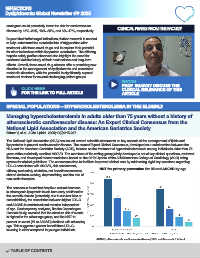
     efficacy and safety of statins, net benefit assessment,   NNT for primary prevention for MI and ASCVD by age
     shared decision-making, deprescribing, and the role of
     non-statin therapies.

     The consensus found that despite a natural decrease
     in atherogenic lipoprotein levels from early adulthood to
     the seventh decade (potentially due to survivor bias or
     comorbidities), the association between higher LDL-C
     and ASCVD is maintained and remains independent
     of age. Contemporary analyses, like the Copenhagen
     General Study, revealed that the absolute risk of events
     is highest in the oldest age group, and the NNT to
     prevent an event (MI or ASCVD) declines with advancing
     age. This suggests a greater benefit from LDL-C-
     lowering in older compared to younger individuals.


                                                            ASCVD, atherosclerotic cardiovascular disease; NNT, number needed to treat.


          TABLE OF CONTENTS

